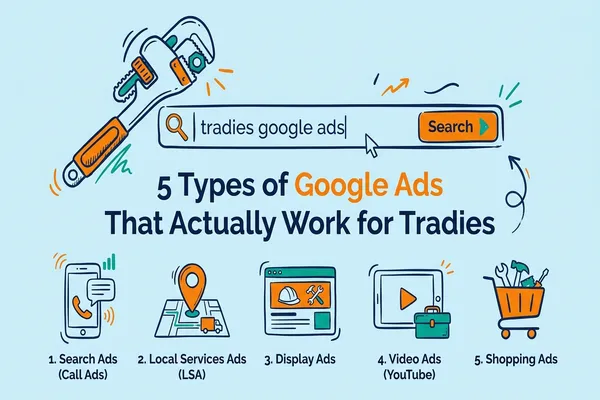
5 Types of Google Ads That Actually Work for Tradies
What if you could pick the right ad type before you spend a cent?
Most tradies start Google Ads the same way. They set up one campaign. They pick some keywords. They send traffic to their homepage. Then they wonder why it did not work.
The problem is not Google Ads itself. It is picking the wrong ad type for your business. Google offers five different ad formats. Each one works differently. Each one costs differently. And only some of them make sense for a local service business.
Here are the five types worth knowing about, and which ones to try first.
1. Google Local Services Ads
This is the one most tradies should start with.
Local Services Ads (LSAs) sit right at the top of Google. Above the regular ads. Above the map results. They show your business name, your reviews, and a "Google Guaranteed" badge.
The big difference? You pay per lead, not per click. That means you only pay when someone actually calls you or sends an enquiry through the ad. No wasted spend on people who click and leave.
To get started, you need to pass Google's screening process. This includes licence checks and insurance checks. Once approved, you get the Google Guaranteed badge. That badge tells customers Google has verified your business.
LSAs work well for plumbers, electricians, locksmiths, and other licensed trades in Australia. If you are in one of the eligible categories, this should be your first move.
2. Search Ads
Search ads are the standard Google Ads most people think of. They show up when someone types a keyword like "mobile mechanic Brisbane" or "emergency plumber near me."
You pick the keywords. You write the ad. You set the budget. When someone searches for your keyword, your ad appears.
The strength of search ads is intent. These people are looking for a service right now. They are not browsing. They want to book someone today.
The risk? Broad keywords eat your budget fast. "Plumber" on its own will cost you plenty and attract clicks from people outside your area. Use specific keywords with your suburb or city name. "Plumber Parramatta" will cost less and bring in better leads than "plumber Sydney."
3. Google Maps Ads
You have probably seen these. They appear at the top of the Google Maps results when someone searches for a service near them.
Maps ads connect to your Google Business Profile. When someone taps your ad, they see your reviews, your phone number, and directions to your business. For mobile operators, they see your service area instead.
This ad type works because the buyer is local and ready. They are looking at a map. They want someone close by. If your reviews are strong, Maps ads can convert at a very high rate.
One thing to note: you need an up-to-date Google Business Profile. If your hours are wrong, your photos are missing, or you have no reviews, the ad will not help much. Fix your profile first.
4. Display Ads
Display ads are the banner ads you see on websites and apps. They show images of your business or your offer while people browse other sites.
For tradies, display ads work best as a follow-up tool. Someone visits your website but does not call. A display ad shows them your business again the next day while they read the news or check the weather. This is called retargeting.
Display ads are cheap compared to search ads. You might pay $0.50 to $2.00 per click instead of $3 to $8. But they are not great for cold leads. People who see your display ad were not searching for your service. They were doing something else.
Use display ads to stay visible after someone has already shown interest. Not as your first ad type.
5. Performance Max Campaigns
Performance Max is Google's newest ad type. It runs across Search, Maps, Display, YouTube, and Gmail all at once. Google's system decides where to show your ad based on who is most likely to convert.
It sounds appealing. One campaign. Every channel. Less to manage.
But there is a catch. Performance Max needs data to work well. Google's system learns from your past conversions. If you are a new advertiser with no conversion history, it has nothing to learn from. Your budget can get spread thin across channels that do not suit your business.
For tradies who have run Google Ads before and have at least 30 conversions per month, Performance Max can work. For beginners, start with LSAs or Search Ads first.
How Much Do Google Ads Cost for Tradies in Australia?
Costs vary by trade and location. But here are some ballpark figures based on current Australian averages.
Cost per click (Search Ads): $3 to $8 for most trade keywords. Emergency services and licensed trades tend to sit higher.
Cost per lead (LSAs): $15 to $50 per lead depending on the trade and city. A plumber in Melbourne will pay more than a cleaner in a regional town.
Monthly budget starting point: $500 to $1,500 per month is enough to test whether ads work for your business. That gives you enough data to see what is and is not working within 4 to 6 weeks.
Display ads: $0.50 to $2.00 per click. Much cheaper, but lower intent.
The most important number is your cost per job. If you spend $600 on ads and get 3 new jobs worth $800 each, your return is strong. If you spend $600 and get nothing, it is time to look at your setup.
Which Type Should You Start With?
If you are new to Google Ads, start with one. Not all five.
For most tradies, the order is:
- Local Services Ads if your trade is eligible. Pay per lead. Low risk.
- Search Ads with tight keyword targeting and a landing page built for enquiries.
- Maps Ads if your Google Business Profile is strong and your reviews are solid.
- Display retargeting once you have traffic to your website and want to follow up with visitors.
- Performance Max once you have conversion data and want Google to find more people like your best customers.
Start with one. Get it right. Then add the next.
Wrapping Up
Google Ads is not one thing. It is five different tools, each with a different job.
Picking the right one for your trade saves money. Picking the wrong one wastes it. If you are unsure which type fits your business, we can look at your setup and point you in the right direction.
Let's chat about your setup. No pressure. Just a clear idea of where your ad budget will go the furthest.
For more on how paid advertising fits into your marketing plan, check out our other guides on the blog.
