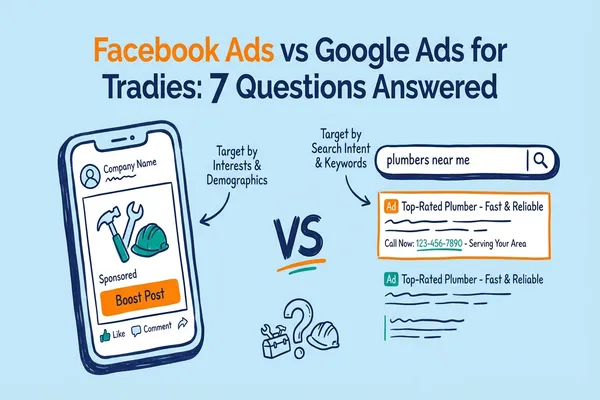
Facebook Ads vs Google Ads for Tradies: 7 Questions Answered
Stuck choosing between Facebook ads for local business or Google Ads for tradies?
You're not alone. Most tradies we chat with feel torn between the two. They want leads, but they don't want to burn a grand on the wrong platform. This post answers the real questions, one by one, in plain English.
Should I start with Facebook Ads or Google Ads as a tradie?
Start with Facebook and Instagram ads. They cost less per lead for most local trades.
Google Ads work best when someone is already searching for a plumber or sparkie right now. That intent is gold, but the click prices have gone up a lot. Facebook lets you reach locals in your suburb before they need you. You build a list of warm leads for less money.
Once you have steady cash flow from Facebook leads, add Google Ads on top. That's the playbook we use with most trade clients.
How are Facebook Ads and Google Ads different for a local service business?
Google Ads catch people in the moment of need. Facebook Ads catch people before they need you.
A bloke types emergency plumber Brisbane into Google. He needs help right now. Google Ads put your name at the top of that search. You pay per click. Click prices for trade keywords in Australia often sit between $8 and $25.
Facebook is different. People scroll Facebook and Instagram while they relax. They are not searching for you. So you need a strong hook and a clear offer. The upside is cheaper reach. You can show your face, your work, and your suburb to thousands of locals each week.
How much should I spend on ads as a tradie?
Start small and prove it works before you scale. Here are rough starting budgets in AUD.
Facebook and Instagram starting spend: $20 to $30 per day. That's about $600 to $900 a month. Enough to test creative and gather leads in one or two suburbs.
Google Ads starting spend: $30 to $50 per day. That's about $900 to $1,500 a month. Click prices for trade keywords run hot, so you need this much to get real data.
Combined budget once both are working: $50 to $100 per day. Split it across both platforms based on what brings the best leads.
Don't go below these numbers. A tiny budget gives you tiny data. You can't tell what works.
What should I expect in the first 30 days of running ads?
The first month is for learning, not for big results. Treat it like a test.
In the first two weeks you'll see clicks and impressions. You may get a handful of leads. Some will be junk. That's normal. Your job is to spot patterns. Which ad gets the most clicks? Which suburb books? Which offer gets ignored?
By week four you should have enough data to cut what's not working. Double down on what is. Most of our clients see steady leads from week five onwards. Anyone promising a flood of jobs in week one is lying.
Do I need a website or a lead magnet to run Facebook Ads?
Yes. Facebook Ads need somewhere to send the click. A lead magnet works best for cold traffic.
A lead magnet is a free gift you give in return for an email or phone number. For a sparkie it could be a free home safety check guide. For a plumber it could be a free leak check. For a removalist it could be a free moving day plan.
The flow is simple. Someone scrolls, sees your ad, taps the offer, gives their details, and lands on your list. Then your CRM follows up by text and email. We set this up for clients as part of our digital marketing services.
Which platform is better for getting jobs this week, Facebook or Google?
Google Ads. If you need calls in the next seven days, Google wins.
People searching mobile mechanic near me want help today. A well set-up Google Ads campaign can get the phone ringing within hours. The catch is you need money on the table. Cheap Google campaigns don't work in trades.
Facebook builds a pipeline. Google fills the diary right now. Both matter. If you only have $20 a day and you need work this week, run a small Google campaign on your top three keywords. If you have $30 a day and you can wait two weeks, start with Facebook.
How do I pick the right platform for my trade?
Match the platform to your buyer's habits and your goal. Here's the simple rule.
Pick Facebook and Instagram first if: You want to grow a list of locals over time. You sell a service people plan ahead for. Think kitchen sparkies, builders, painters, removalists, tile cleaners.
Pick Google Ads first if: Your work is urgent and unplanned. People search for you when something breaks. Think emergency plumbers, locksmiths, blocked drain crews, hot water repairs, mobile mechanics for breakdowns.
Run both once you can afford it: Facebook builds the list. Google catches the urgent jobs. Together they cover the full buyer journey.
For setup help and rules on ad accounts, the Google Ads Help Centre is a solid starting point.
What's a fair cost per lead for tradies in Australia?
A fair cost per lead in Australian trades sits between $20 and $80. It depends on your trade, your suburb, and your offer.
Facebook and Instagram leads: Usually $15 to $50 per lead in most trades. Cheaper in regional areas. Higher in big cities like Sydney and Melbourne.
Google Ads leads: Usually $40 to $120 per lead. Higher click prices push the cost up. The trade-off is buyer intent. Google leads often book faster.
If your cost per lead sits inside these ranges and you close one in three, you're winning. If you're paying $200 a lead and closing one in ten, something is broken in the funnel.
Still stuck on which one to pick?
Most tradies waste money guessing. We help you pick the right platform, set the budget, and write ads that get booked jobs. Let's chat about your setup. Book a free strategy call.
