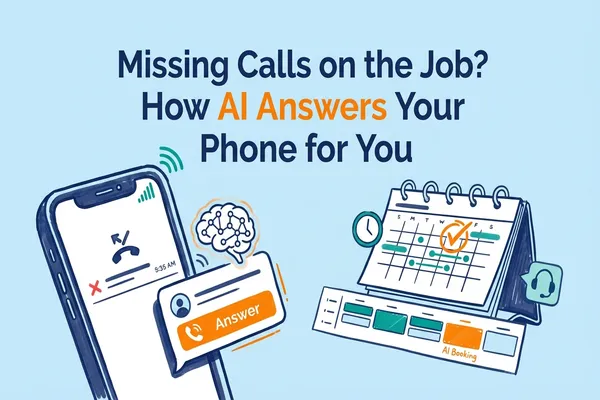
Missing Calls on the Job? How AI Answers Your Phone for You
You're halfway through a brake job. Your phone rings. You can't answer. That's a customer gone.
One missed call doesn't sound like much. But add it up. Three missed calls a week at $300 per job is $900 lost. Over a year, that's $46,800 in work that went to whoever picked up first.
You can't answer every call when you're on the tools. But AI can. And it's not the robotic "press 1 for sales" system you're thinking of. It's a real conversation.
Why This Keeps Happening
Service businesses run on phone calls. Customers don't want to fill out a form and wait. They want to talk to someone now. If nobody answers, they call the next business on the list.
But you're a one-person or two-person operation. You're driving, working, quoting, or covered in grease under a car. You can't sit by the phone all day. That's not how trade businesses work.
Voicemail doesn't fix it either. The Yellow Pages Business Insights found that most callers won't leave a voicemail for a business they've never used before. They just hang up and try someone else.
So the customer calls, nobody answers, and you never know they existed. No missed call notification is going to help when they've already booked with your competitor.
What Is AI Phone Answering?
An AI phone system picks up when you can't. It sounds like a real person having a real conversation. It answers questions, takes booking requests, and sends you the details by text.
Here's what a typical call looks like:
Step 1: Customer calls your business number.
Step 2: AI answers with your business name. "Hi, thanks for calling Dave's Mobile Mechanics. How can I help?"
Step 3: Customer says "I need a car service at my place in Penrith on Thursday."
Step 4: AI confirms the request, collects their name and number.
Step 5: You get a text with all the details: name, number, location, what they need, and when.
The customer gets an instant response. You get a qualified lead. Nobody waits.
This isn't a robot reading a phone menu. Modern AI voice systems understand natural speech. The caller talks normally, and the AI responds like a helpful receptionist who knows your business.
What Can AI Handle on the Phone?
More than you'd think:
Answer common questions.
"What areas do you cover?" "How much is a standard service?" "Are you available this week?" "Do you work on weekends?" The AI knows your answers because you set them up when it's configured.
Take booking requests.
It collects the customer's name, phone number, location, and what they need. Then it texts everything to you in a neat summary.
Send follow-up texts.
After the call, the AI can text the customer to confirm their request was received. This builds trust and stops them from calling someone else.
Work 24/7.
Nights, weekends, public holidays. No sick days, no annual leave, no award rates. Every call gets answered, even at 2am when someone's car breaks down and they want to book a mechanic for the morning.
Speak naturally in Australian English.
You choose the voice (male or female, Australian accent). It sounds local, not like an overseas call centre.
It can't do everything. Complex quotes, complaints, or unusual requests still need you. But 70-80% of inbound calls to a service business are simple enquiries or booking requests. AI handles those while you work.
What Does It Cost?
Less than you'd think. And much less than the work you're losing.
Part-time receptionist: $2,000-$3,000/month
Virtual receptionist service: $200-$500/month (limited hours)
AI phone answering: $300-$500/month (24/7, unlimited calls)
Doing nothing (missed calls): $900+/week in lost work
AI phone answering pays for itself if it catches one extra job per week. For most tradies, it catches several.
What Does It Sound Like?
Here's a sample conversation a mobile mechanic's AI might handle:
AI: "Hi, thanks for calling Jake's Mobile Mechanics. How can I help today?"
Caller: "Yeah, my car's been making a weird noise when I brake. Can someone come have a look?"
AI: "Sounds like it could be your brake pads. We can come to you for a check. What suburb are you in?"
Caller: "I'm in Blacktown."
AI: "Great, Blacktown is in our service area. Can I get your name and number so Jake can call you back with a time?"
Caller: "Sure, it's Sarah, 0412 345 678."
AI: "Thanks Sarah. Jake will get back to you within an hour. Is there anything else I can help with?"
Jake gets a text: "New lead: Sarah, 0412 345 678, Blacktown, brake noise, wants an inspection." He calls back on his lunch break and books the job.
How Does It Get Set Up?
Light Leads sets up AI phone answering tailored to your business. Here's what the process looks like:
We learn about your services, pricing, service area, and common questions
We build a knowledge base so the AI knows your business inside out
We configure the voice, greeting, and response style
We test it with real call scenarios
We connect it to your business number (calls forward when you don't answer)
The whole setup takes a few days. After that, it runs on its own. You get a text every time it handles a call.
The Bottom Line
You can't grow a service business if half your calls go to voicemail. AI phone answering catches those calls, books those jobs, and pays for itself in the first week.
Want to see how it works for your trade? Book a free call.
